Hopscotch, Skipping and Sneaky Sums: 12 Playground Classics That Build Number Confidence
The British playground is a maths classroom in disguise. No interactive whiteboard, no worksheet, no login details. Just chalk, a skipping rope, a handful of marbles and a group of children who are accidentally practising numeracy while having a brilliant time.
That is the beauty of playground games. They serve up counting, scoring, measuring, pattern-spotting and strategic thinking without announcing any of it. At Math Playgrounds, we are all for screen-based games, but there is something special about maths that happens at top speed with cold hands and a bit of noise.
Here are 12 classic playground games and the maths hiding inside them. Most need little or no equipment. All can be nudged up or down a level with a quick word from a parent or teacher.
1. Hopscotch
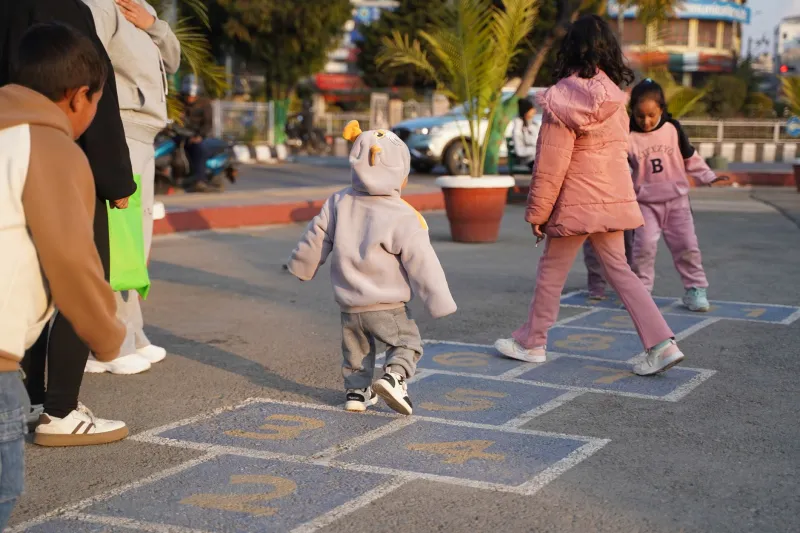
Chalk a grid, number the squares and off you go. Hopscotch is number recognition, sequencing and counting in one happy package. Children also meet odd and even numbers, and they estimate how hard to throw a stone. For KS1, keep the grid to 1 to 10. For KS2, write times table answers in the squares and call out the matching question. Ask older children to design a grid with a pattern, such as multiples of three.
2. Skipping Rhymes
Skipping is counting with a beat. Traditional rhymes like 'One potato, two potato' or 'Salt, mustard, vinegar, pepper' build rhythm, memory and sequence. A child who skips while chanting multiples of five is doing times tables with their whole body. KS1 can count in ones and twos; KS2 can skip to 3s, 4s or 6s and spot the pattern when the numbers get bigger.
3. What's the Time, Mr Wolf?
This one is a masterclass in time language and strategic risk. Children chant the question and Mr Wolf answers with o'clock times, then creeps closer. KS1 can use o'clock and half past. KS2 can add quarter past, quarter to and simple durations. Ask: How many steps might Mr Wolf take next? How far away is he? It is estimation, time vocabulary and a tiny bit of drama.
4. Marbles
Where marbles are allowed, they bring scoring, counting and probability into the playground. Children count wins, keep a tally and compare scores. They also judge distance and angle as they aim. KS1 can simply count marbles in and out of the ring. KS2 can calculate totals, find differences and talk about whether a shot is likely or unlikely. A quick tally chart turns playtime into data handling.
5. Conkers
Conkers is a classic British autumn game, and it is packed with counting and scoring. Each hit can be counted, scores can be compared and children can estimate how many hits a conker might survive. Follow school rules and safety guidance, and use protective goggles where required. For maths talk, ask children to record scores in tens and ones, or work out how many more hits one conker needs to catch another.
6. Clapping Games
Clapping games are pattern machines. Children repeat sequences, keep a steady beat and remember increasingly complicated hand movements. That is pattern recognition, memory and sequencing, all wrapped up in a rhyme. KS1 can clap a simple count of one to five. KS2 can build a clapping pattern with two rules, such as clap on multiples of three and stamp on multiples of five. Ask them to explain the pattern to a partner.
7. Please Mr Crocodile
Children ask, 'Please, Mr Crocodile, may I cross the river?' and the crocodile gives a number of steps. This game is full of counting, measuring and estimation. KS1 can take small steps and count them aloud. KS2 can estimate how many steps it will take to cross, then check and compare. Use different step sizes, such as giant steps and baby steps, and talk about why the number changes. That is measurement with a grin.
8. Fruit Salad
In Fruit Salad, children are given fruit names and swap places when their fruit is called. It looks like chaos; it is actually sorting and categorising. Count how many children are in each fruit group. Compare group sizes using more than, fewer than and difference. KS1 can use three fruits and count the groups. KS2 can turn the groups into a simple bar chart or work out fractions: what fraction of the class are apples?
9. Elastics
Elastics is a skipping game with a stretchy rope around ankles, knees or waists. Children jump in patterns, count jumps and measure the height of the elastic. That is counting, sequencing and measurement in one. KS1 can count jumps to five and practise the pattern. KS2 can measure the elastic height with a ruler, record results and compare. Ask them to design a new jumping pattern with a repeated sequence.
10. Hide and Seek
Hide and Seek starts with counting to 20, 50 or 100, and that is only the beginning. Children use positional language, estimate where someone might hide and think strategically about the best spots. KS1 can count to 20 with support. KS2 can count in twos, fives or tens, or count backwards from 100. After the game, ask: Which hiding place was most popular? How could we show that as a tally?
11. Chain Tag
In Chain Tag, the person who is 'on' links arms with each person they catch, creating a growing chain. It is counting, teamwork and strategy. Count the links in the chain. How many more people are needed to make a chain of ten? KS1 can count the chain aloud. KS2 can track the number of players left and discuss the best tactic for the chain. It is live number sense with a side of sprinting.
12. Shape Simon Says
A quick twist on Simon Says: 'Simon says make a triangle with your arms.' 'Simon says find something rectangular.' Children use shape vocabulary, position words and quick thinking. KS1 can name circles, squares and triangles. KS2 can add 3D shape names, symmetry and angle language. Ask a child to be Simon and give a shape instruction that the group must follow. It is a warm-up for geometry that costs nothing and takes two minutes.
How to Turn Play into Maths Talk
The secret is not to turn playtime into a quiz. Ask one good question and then let the game carry on. 'How many more?' 'What pattern do you notice?' 'Can you estimate first?' 'How could we check?' These questions keep the maths light and the play in charge.
Teachers can train playground leaders to run a maths-themed game once a week, or add a chalk number line to the playground. Parents can join in at the park and ask a single maths question on the walk home. Mixed-age groups work well too: older children explain the scoring, younger children count the jumps.
Adapting for Ages and Abilities
For KS1, keep numbers small and use fingers, counters or chalk marks. Let children count aloud together. For KS2, add reasoning: Can you find a quicker way? What would happen if the numbers were doubled? For children who need extra support, reduce the number range, model the counting and keep the game short. For confident children, add a rule or a bigger number rather than more questions.
Playground maths works because it is social, active and low-stakes. Children retrieve number facts, make estimates and solve small problems without feeling like they are in a maths lesson. The next time you see a hopscotch grid or hear a skipping rhyme, listen closely. There is a lot of counting going on.