Open a Door, Solve a Puzzle: 24 Five-Minute Maths Games for December 2026
December is lovely and chaotic in equal measure. There are nativity costumes to locate, cards to write, sprouts to buy and a small person asking whether it is Christmas yet. Again. A maths advent calendar might sound like one more job, but it works best when it is tiny. One door, one five-minute game, one small burst of number confidence before the day runs away with you.
At Math Playgrounds, we like maths that feels like play rather than a worksheet in a party hat. So this December 2026 calendar is deliberately low-effort. You do not need an app, a printer or a spare hour. You need 24 envelopes, some paper, a pencil and a willingness to count baubles while eating toast.
Set Up Your Maths Advent Calendar
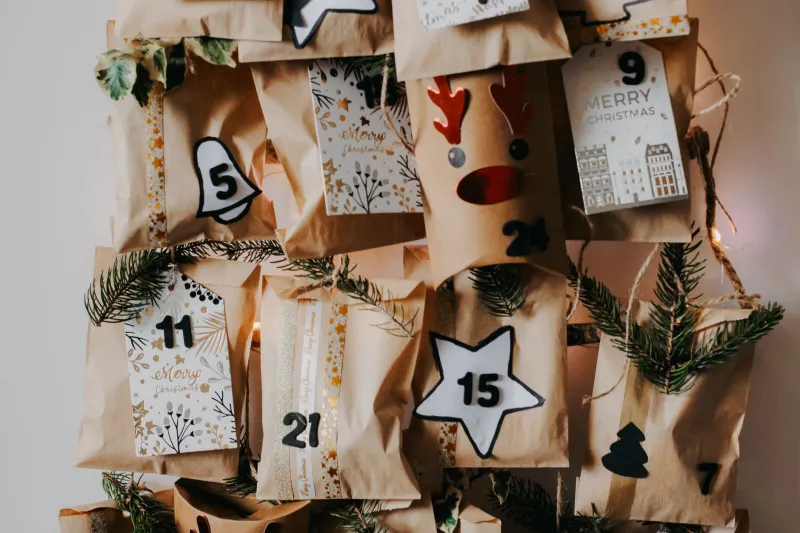
Number 24 envelopes or small paper bags and stick them to a wall, a cupboard door or a classroom display. Inside each one, pop a challenge card. You can write the game name and a one-line instruction, then let the child lead. Chocolate is optional. Curiosity is not.
For parents, the best slot is often breakfast or the post-tea lull. For teachers, the calendar makes a neat morning starter or a five-minute filler before assembly. Keep it short. The aim is a daily dab of numeracy, not a full lesson in festive wrapping paper.
Week One: Number Warm-Ups (Days 1 to 6)
- Christmas Countdown. Count backwards from 24 to 1. For KS1, use a number line. For KS2, ask what happens when you cross a multiple of ten.
- Bauble Sort. Sort decorations by colour, shape or size. Count each group and compare totals using more than, fewer than and difference.
- Times Table Tinsel. Roll two dice, multiply the numbers and colour a paper bauble. KS2 can use 1 to 12 dice or playing cards.
- Fraction Fruitcake. Cut a paper cake into halves, quarters and eighths. KS1 can fold and count equal parts; KS2 can compare fractions.
- Coin Count. Give three toy gifts simple price tags under £10. Make each amount with real or paper coins. KS2 can work out change from £10.
- Shape Santa. Draw Santa using circles, triangles and rectangles. Count the sides and corners, then spot any symmetry.
Week Two: Money, Measure and Movement (Days 7 to 12)
- Advent Money Match. How many ways can you make 7p? Or 17p? Use 1p, 2p, 5p and 10p coins. KS1 can start with 5p; KS2 can find all possibilities.
- Wrap Race. Cut three lengths of ribbon and order them from shortest to longest. Estimate first, then measure with a ruler or a strip of paper.
- Symmetry Snowflakes. Fold paper, cut a pattern and open it out. Talk about lines of symmetry. KS1 can make big bold shapes; KS2 can design a snowflake with two lines of symmetry.
- Step Counting. Count stairs, steps to the kitchen or hops across the room. Estimate first, then check. KS2 can compare estimates and find the difference.
- Christmas Clock. Order the day's events, such as breakfast, school, tea and bedtime. Read the times together. KS2 can work out how long until an event.
- Recipe Halves. Halve a simple recipe, such as fairy cakes or porridge. KS1 can halve objects; KS2 can halve amounts like 150g or 300ml.
Week Three: Problem-Solving and Patterns (Days 13 to 18)
- Elf Logic. Three elves, three hats, three clues. Who wears which hat? KS1 can solve with pictures; KS2 can write a short explanation.
- Pattern Presents. Make a repeating pattern with coloured squares: red, green, red, green. KS2 can build a pattern with two rules, such as colour and shape.
- Christmas Tree Sums. Use three numbers to make 12. How many ways can you find? KS1 can use counters; KS2 can look for a system.
- Shape Hunt. Find 3D shapes around the house: a cuboid cereal box, a cylinder tin, a sphere orange. Count faces, edges and vertices.
- Graph the Greens. Do a mini tally of favourite festive foods, then turn it into a simple bar chart. KS1 can use pictures; KS2 can label axes.
- Cracker Combinations. How many different pairs can you make from four cracker jokes? KS2 can list systematically; KS1 can act it out with cards.
Week Four: Festive Challenges (Days 19 to 24)
- Gift Grid. Draw a simple grid on wrapping paper. Give coordinates for a hidden sticker. KS1 can use left, right, up and down; KS2 can use letter-number coordinates.
- Estimate the Sweets. Fill a jar with small sweets or counters. Estimate, count in groups of ten and compare.
- Twelve Days Maths. Count the gifts mentioned on each day of the song. Look for patterns. KS2 can add the daily totals.
- Santa's Route. Draw a simple map with three houses. Find the shortest route. KS2 can measure with a ruler and compare routes.
- Bake Sale Budget. You have £10. Choose three items from a made-up price list. Can you afford them? What change do you get?
- Christmas Eve Countdown. Count the hours or minutes to a set event, such as bedtime or present time. KS1 can count sleeps; KS2 can work out elapsed time.
Making It Work for Different Ages
For KS1, keep numbers small and hands busy. Use counters, number lines, real coins and plenty of talk. Read the challenge aloud and let the child explain what they notice. For KS2, add a gentle nudge: Can you prove it? Can you find another way? What would happen if the numbers were bigger?
Teachers can use the same calendar as a mixed-ability starter. Pair children so one reads and one records. Parents can ignore the clock. If a game takes two minutes, brilliant. If it sparks a ten-minute debate about the fairest way to share sprouts, even better.
Why Five Minutes Is Enough
Little and often beats one big festive maths marathon. A short daily game keeps number ideas ticking over without turning December into a test. It also gives children a chance to retrieve what they know, talk about strategies and make mistakes in a low-stakes setting. That is game-based learning doing its quiet, useful work.
Make your calendar as polished or as scrappy as you like. The important part is the door, the question and the five minutes together. Happy counting, and may your baubles be plentiful.