After the Clocks Change: A Torch-and-Chalk Maths Hour for November Playgrounds
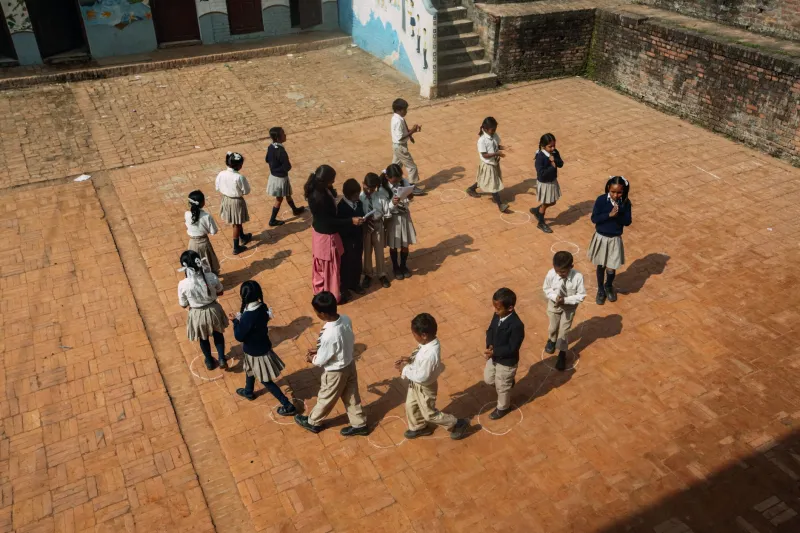
By 4pm on a November afternoon in the UK, most playgrounds have lost their best light. That does not mean they have lost their uses. After the clocks went back in late October 2026, plenty of families and schools are looking at a stretch of grey, drizzly dusk and wondering how to make it feel less like a countdown to the sofa.
A torchlit maths session is not about turning a dark playground into a sports hall. It is a short, slightly magical change of scene: 20 to 30 minutes, a few simple bits of kit, and games that use the dark as part of the fun rather than pretending it is not there. The maths is still ordinary – counting, adding, shape, measure – but the setting gives it a different sort of pull.
Before You Switch On: A Five-Minute Set-Up
You do not need much: a pot of playground chalk, two or three torches, a pack of glow sticks or glow markers, a few cones, and some laminated number cards if you want to avoid writing in the wet. Check torch batteries at home rather than in the middle of a game. Keep the play area small and obvious, with an adult at the main exit and a clear boundary such as a line of cones or a painted edge.
Safety first, always: no shining torches into eyes, no running with a torch in hand, and no wandering beyond the agreed zone. Wet leaves and dark corners are a poor mix, so choose a flat, familiar surface and do a quick walk-round before children arrive. High-visibility tops or armbands are worth the fuss. If the playground is school property, follow the usual supervision ratios and let the site manager know about chalk use.
And keep the session short. Cold fingers stop being playful quite quickly. A 20-minute burst with a warm finish works better than a heroic 45-minute mission.
1. Chalk Number Hunt
Write numbers around the play area before the children go out – large enough to spot with a torch, small enough to need a bit of searching. Call out a target, such as find two numbers that make 10, or find the number that is one more than 14. Children sweep their torch beams across the ground and call back when they find a match.
For younger children, chalk dots and numerals for matching is enough. For Year 2 and Year 3, ask for pairs that add to a target. Older children can hunt for numbers that make a multiplication fact, or find three numbers with a total of 30. The maths is number recognition, addition and mental recall, but the torch makes the searching feel like a proper job.
2. Beam and Balance
An adult uses a torch to make a spot of light on the ground a few steps away. The child walks to it, says the next number in a sequence, then waits for the next spot. Start with simple counting, then move to counting in twos, fives or tens. For a stretch, try one more and one less, or double the number you land on.
This one suits children who like a clear route and a bit of movement without a race. Keep the spots close together and the pace calm. If you have a child who finds waiting hard, give them the torch for the next round and let them set the spots for someone else.
3. Glow-Stick Shape Sort
Make simple shapes on the ground with glow sticks: a square, a rectangle, a triangle, a pentagon. Children use torches to find them, then sort them by a property – shapes with four sides, shapes with a right angle, shapes with no straight sides. For older children, give each glow stick a pretend length of 10cm and ask them to work out a perimeter.
This is a nice one for mixed ages because the same set-up can be used at different levels. Reception children can simply name and match shapes. Year 4 can talk about parallel sides. Year 6 can estimate area by counting squares drawn in chalk around the shape. The dark does not change the geometry; it just makes the edges glow.
4. Shadow Sums
Put a cone or a child’s hand in front of a torch and look at the shadow on the ground. Measure it in shoe lengths, hand spans or chalk marks. Then move the torch closer and measure again. What happened? Why?
This is measurement with a bit of mystery. Younger children can count how many shoes long the shadow is. Older children can compare two shadows and find the difference, or double and halve the measurements. Keep the torch low and steady, and remind everyone not to look into the beam. A clipboard or a grown-up scribe helps if you want to record the results before fingers get too cold.
5. Torch Relay Arithmetic
Set out two cones a short walk apart. Put a small stack of number cards by each cone. Teams take turns to walk briskly to the cone, pick a card, answer the question an adult calls out, and walk back. The next person goes when the card is returned. No sprinting, no torch waving – steady feet and loud answers.
Use questions that match the group: number bonds to 10, doubles, times-table facts, or missing-number sums. The relay format adds pace without turning the whole thing into a race against the clock. For children who prefer not to take part in the walking, the scorekeeper role is a real one: they can check answers, keep tally and announce the total at the end.
6. Quiet Constellation Counting
Not every child wants to charge about in the dark. Set aside a calm corner with a bench, a mat or a dry ledge, and give children a dark card with small glow stars stuck on it. Ask them to count the stars, make a constellation shape, or work out how many are left if two disappear behind a cloud. A torch covered with a tissue makes a softer beam for close-up work.
This is still maths – counting, subtracting, pattern-spotting – but it gives quieter children a way in without demanding that they perform in front of a crowd. It also gives adults a useful place to stand with the first-aid kit and the spare gloves.
The Warm-Up Matters More Than the Wow
A torchlit playground is memorable, but the learning comes from the talk around it: What did you find? How do you know? Can you show me another way? Keep the questions short and let children explain with their torches and chalk marks. If a game flops, stop it. If a child finds a puddle more interesting than a number, that is feedback, not failure.
The best November sessions are the ones that finish while everyone still has cold cheeks and good tempers. Ten minutes of chalk, ten minutes of torch games, a quick count-up of glow sticks, and back inside for hot squash. Maths has had a proper outing, and nobody has had to pretend that 4pm is still the middle of the afternoon.