Shoebox Maths: Fifteen Screen-Free Games for a Tenner on a Wet Saturday
The tenner challenge
The clocks have gone back, the back garden is more mud than lawn, and Saturday stretches ahead like a wet blanket. That is exactly when a small box of maths games earns its keep. The aim here is not to recreate school at the kitchen table. It is to keep numbers ticking over while the rain hits the windows — and to do it for about £10.
Everything below can be found in Poundland, a charity shop, a supermarket value aisle or the back of a cupboard. The kit is reusable, screen-free and small enough to live in a shoebox. Most games take five to fifteen minutes, which is about right for a dark autumn weekend.
What goes in the shoebox
A workable £10 haul:
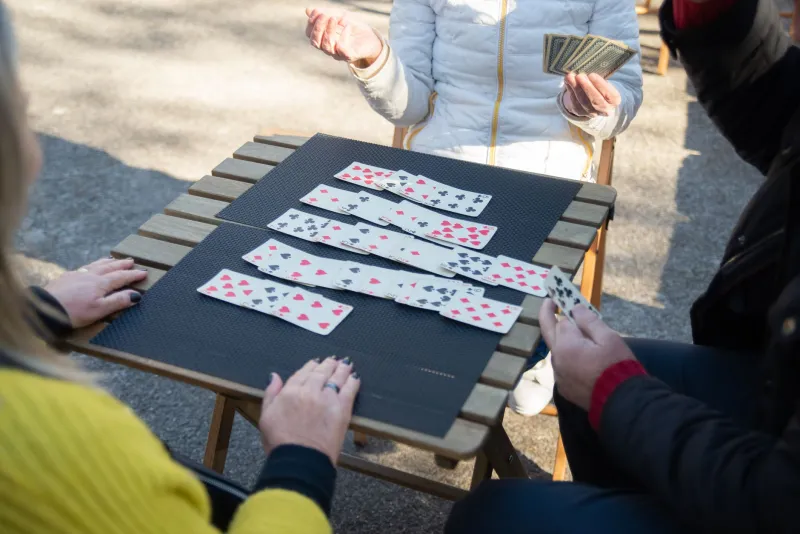
- Two packs of playing cards — about £2
- Two sets of dice — about £2
- One domino set — £1 to £2 from a charity shop
- Paper cups — £1
- Sticky notes and a marker — about £1.50
- A bag of pebbles — free from a park or beach, or £1 from a garden centre
- A shoebox or zip-up bag — £1 or free
That totals roughly £10, with a little wriggle room. Check charity shops for dominoes and playing cards first; missing pieces are fine as long as you have enough to play. Keep small pebbles away from children under three.
Fifteen games for a wet weekend
1. Cup Stack Sums (ages 4-7). Write numbers 1 to 10 on paper cups. Call out a target, such as 7. Your child stacks two or three cups whose numbers add to the target. For an extra step, allow subtraction: 10 minus 3 also makes 7.
2. Pebble Tens Frame (ages 4-6). Draw a 2 by 5 grid on paper. Put some pebbles in the frame and ask how many more are needed to make 10. Swap roles so your child sets the puzzle.
3. Domino Doubles Dash (ages 5-7). Turn over a domino and double the total number of pips. The first player to say the answer keeps the domino. This is quick, noisy and good for early recall.
4. Card War: Times Tables Edition (ages 8-11). Remove the face cards or agree that jack equals 11, queen 12 and king 13. Flip two cards and multiply. The higher answer wins the pair. A multiplication grid on the table keeps it friendly.
5. Place Value Shuffle (ages 6-9). Draw three cards and make the largest three-digit number you can. Then make the smallest. Ask which is bigger and by how much. Ace counts as 1.
6. Dice Place Value Build (ages 7-10). Roll three dice and build a three-digit number. Ask your child to add 10, subtract 100 or make the largest even number possible. Small changes keep the same dice useful.
7. Domino Fractions (ages 7-11). Pick a domino. Ask what fraction of the total pips is on the left side. For a 3-4 domino, the left side is 3 out of 7. Simplify where possible.
8. Card Fraction Pairs (ages 8-11). Deal four cards to each player. Build a fraction less than one and compare with your partner. The larger fraction wins the round. For a challenge, hunt for equivalent fractions.
9. Pebble Place Value (ages 6-9). Give your child a pile of pebbles. Ask them to make groups of ten. Count the tens and the leftovers, then write the number. This is concrete place value without a worksheet.
10. Dice Rounding Race (ages 8-10). Roll three dice to make a number. Round it to the nearest 10 and the nearest 100. First correct answer scores a point. Keep the pace brisk.
11. Cup and Pebble Shake (ages 5-8). Put five pebbles under a cup. Show your child two pebbles and hide the rest. How many are hidden? This works for number bonds to 5, 10 or 20.
12. Times Table Tower (ages 8-11). Each correct times table fact earns a playing card. Players build a tower. First to ten cards wins. Use a six-second timer to mimic the pace of a quick recall check.
13. Domino Match (ages 5-8). Each player turns over a domino and adds the pips. The higher total wins. For variation, set a target such as 10 and see who can get closest.
14. Card Target 24 (ages 9-11). Turn over four cards. Use addition, subtraction, multiplication and division to make 24. This is a classic reasoning challenge and works well as a cooperative puzzle.
15. Dice Difference (ages 6-9). Roll two dice and subtract the smaller number from the larger. Score the difference. First to 20 points wins. It is simple, fast and sneaks in plenty of subtraction practice.
Keeping the kit alive
The trick is not to play all fifteen in one afternoon. Pick three, play them for ten minutes and put the box away. Rotate the games across the weekend so the kit feels fresh rather than like homework in disguise. A sticky note on the lid with the current favourites is enough.
Add a small whiteboard or a stack of scrap paper if you have them, but do not spend beyond the tenner. The point is that maths can be playful, portable and cheap. When the rain clears, the same pebbles and dice can go outside. Until then, the shoebox does the job.