Follow the Spine: A Library Number Trail That Turns Shelves Into Clues
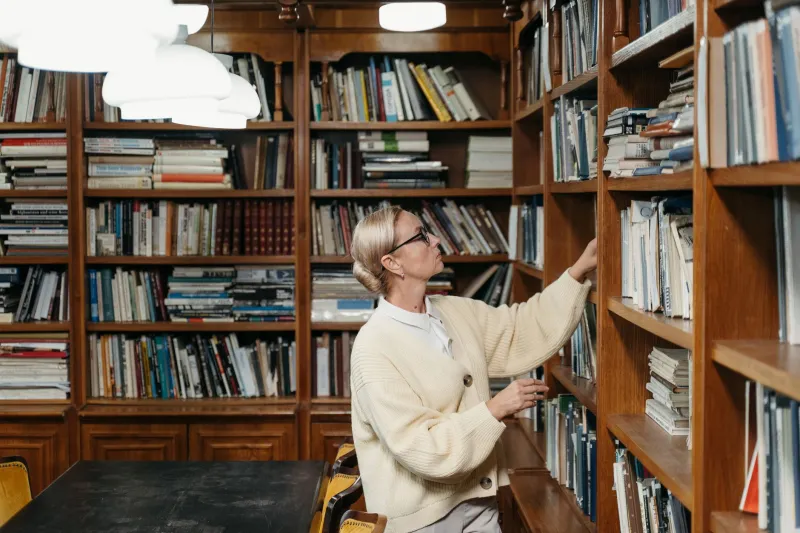
There is a particular kind of November Saturday where the rain settles in, the park is a swamp, and the only free indoor space with chairs is the library. Most parents treat it as a shelter with books. Maths-wise, though, it is one of the best-equipped buildings in town — and it has been the whole time.
Think about what is actually on those shelves. Every non-fiction spine carries a number. Those numbers sit in order, in bands, in intervals, with decimal points doing real work. Behind the scenes, a librarian is running a giant sorting system with ten top-level buckets and a hundred sub-buckets, and your child can walk along it with a finger. That is place value you can touch.
So instead of a mad dash to the children's corner and a negotiation over the beanbags, try a trail. Thirty minutes, four or five clue cards, one pencil each. Here is how to put it together.
Why the shelves already do the teaching
The Dewey system runs from 000 to 999, then breaks each hundred into tens, then into decimals. For a five-year-old, that is simply 'big numbers get bigger along the shelf'. For a nine-year-old, it is a live demonstration of ordering, intervals and place value — the digit in the tens column tells you which bay, the digit in the units column tells you roughly where on the bay.
Fiction is alphabetical, which is a different skill, so keep the trail in non-fiction where the numbers live. A quick word with the desk staff first is polite and often useful — many libraries already have their own maths or treasure-hunt sheets, and some will let you know which bays are quiet that morning.
Building the trail at the kitchen table
You need about twenty minutes and a printer, or a pen and some index cards. Aim for four or five stations. Each card does two jobs: it gives a task, and it hands back one digit. Collect all the digits and they form a four-digit number, which is the combination for a small padlock on a pencil case, or simply the number written inside a sealed envelope with a bookmark in it.
A few ground rules worth agreeing before you go in:
- Quiet voices, walking feet, one shelf at a time.
- Books go back where they came from, or into the returns trolley — never reshelved wrongly.
- Nobody climbs. The bottom two shelves are the whole playground.
Clue ideas for KS1
Keep the tasks physical and short. Reception and Year 1 children are doing comparison and counting, not classification.
- Find the book on this shelf with the biggest number on its spine. Write the last digit.
- Count how many books are in the 500s bay. Is it more or fewer than ten?
- Which is thicker — the atlas or the dictionary? Guess first, then check.
- Find a book with a page number ending in zero and write that number's first digit.
- Find three books about animals. Put them in order from thinnest to thickest.
Clue ideas for KS2
This is where place value and data handling earn their keep.
- Find three spines where the tens digit is 7. What is the smallest number you found?
- How many books sit between 641 and 642 on the shelf? (The answer is usually a satisfying surprise.)
- Choose five books. Estimate the page count of each from its thickness, then check the last page number. Who was closest?
- Tally the books in one bay by subject — how many on pets, how many on space, how many on cooking?
- Write down four spine numbers. Add the digits of each. Which total is largest?
Making the code pay off
If every card returns a single digit, the tension builds nicely: children start predicting what the number might be, which is estimation by stealth. The final number can open a padlock, match a label on a particular shelf, or simply be the page you turn to in a book you have brought from home. Keep the payoff small and quick — the trail is the treat, not the prize.
The journey home is station five
Back at the table, the tally from the shelf bay becomes a bar chart on the back of an envelope. The five page counts become a line of numbers to order and compare. If you have a KS2 child who enjoys a stretch, ask for the difference between the longest and shortest book, or a rough mean. Ten minutes, no worksheet, and the data is theirs.
Variations worth trying
- Half-term edition: add a station in the reference section and one at the noticeboard, where the numbers are dates and opening hours rather than spines.
- School library version: run it as a lunchtime club with Year 5 as clue-writers for Year 2. Writing good clues is harder than answering them, which is the point.
- The reservation challenge: give a target number and ask them to find the nearest book to it. Close counts.
What is actually being learned
Ordering, place value, estimating, comparing, tallying and a first taste of classification — plus the quieter lesson that numbers are a system for finding things, not just something you do on a Tuesday morning. A child who can navigate a shelf by number has met the same idea that runs a spreadsheet, a bus timetable and a library catalogue.
And on a wet Saturday in November, that is a genuinely good use of an hour. Take a pencil. Thank the staff on the way out.