Run, Hide, Count: The Playground Game That Sneaks in More Maths Than a Worksheet
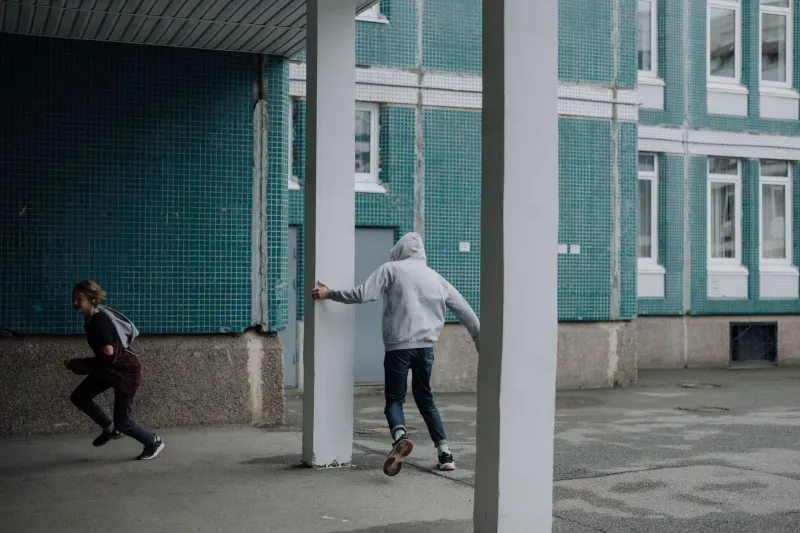
Hide-and-seek is one of those playground games that adults tend to leave alone. Good. It does not need a clipboard, a timer or a learning objective stuck to it. But watch a round closely and you will see children counting, estimating, mapping, negotiating and taking risks with numbers. The maths is already there. The trick is knowing where to look — and how to add a small twist without spoiling the game.
The Count Is Doing More Than You Think
When the seeker closes their eyes and counts to twenty, they are not just filling time. They are practising number order, one-to-one correspondence and the idea that the last number tells you how many. That is counting fluency, even if nobody says so.
You can vary the count without turning it into a drill. KS1 children might count to 20 in a steady voice, then try counting backwards from 10. KS2 children could count to 60 in fives, or count down from 30. The point is not speed. A seeker who rushes and loses their place is learning something useful too: slow down, reset, start again. That is self-regulation, and it sits right next to maths.
A simple rule helps: the count has to be loud enough for hiders to hear, and clear enough for everyone to trust. If the count is mumbled, the game breaks down. If it is clear, hiders can use it to estimate how long they have left. Already, the numbers are doing work.
Estimating Is the Real Skill
Hiding is full of estimates. How long until the seeker reaches forty? How far is that bush from the base? Can I get there before they turn around? None of these questions need a ruler. They need a feel for distance, time and risk — the everyday side of number sense.
Listen for the language children use: 'a bit further', 'about ten steps', 'closer to the wall', 'roughly halfway'. That is estimation talk. You can gently add to it by asking, 'Do you think that spot is nearer or further than the climbing frame?' or 'How many giant steps to the base?' Keep it light. One question is plenty. A full interrogation is not a game.
Chalk Maps and Zone Rules
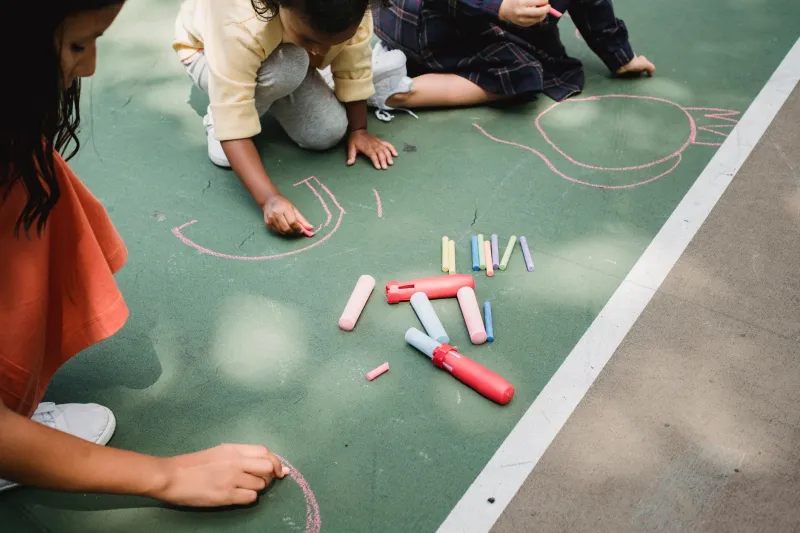
A piece of playground chalk can turn hide-and-seek into a spatial reasoning challenge. Before the first round, draw a simple map of the play area: the base, the main equipment, the safe zones and a few 'shadow zones' behind walls or trees. Let the children mark where they hid with initials or a dot. After a few rounds, look at the map together. Which zones get used most? Which are always empty? Why might that be?
For KS2, you can chalk a rough grid over the map and ask children to describe a hiding spot using squares: 'two squares left of the base, one square behind the bench'. That is coordinate language in disguise. For KS1, keep it simpler: draw coloured zones and ask children to choose a colour before they hide. 'I am in the green zone' is a positional statement, and it helps everyone build a shared picture of the space.
The map is not a worksheet. It is a talking point that happens to sit on the ground.
Seekers' Odds: A Fair-Play Scoreboard
Fairness is a numbers conversation waiting to happen. Younger children often hide in the same obvious spots; older children get faster and more tactical. A simple odds game can level things up without taking over.
Try this. Mark a few hiding spots as one-point, two-point or three-point spots, depending on how easy they are to find. If a hider is found, the seeker gets the points. If a hider survives until the seeker has counted to sixty, the hider gets the points. Suddenly children are weighing risk against reward: is it better to take the easy spot near the base or the risky spot behind the shed?
You can also let the seeker predict how many hiders they will find in the first minute. One, two, three? After the round, compare the prediction with the result. That is a gentle introduction to probability and to the idea that predictions can be useful even when they are wrong.
The key is negotiation. Children will want to adjust the rules: faster seekers get fewer points, smaller areas get shorter counts, younger hiders get a head start. Let them argue it out. That argument is the maths.
Strategy Talk Without the Worksheet
At the end of a round, try a two-minute chat. Not a sit-down lesson — just a few questions while everyone catches their breath.
- Which spot gave you the best chance of staying hidden?
- What made the seeker slow down?
- Was it better to hide close to the base or far away?
- Did anyone change their mind after the first round?
You can introduce words like likely, unlikely, fair, risk and estimate without writing anything down. If children disagree, even better. Ask them to explain their thinking in one sentence. That is reasoning, and it belongs in the playground.
KS1 and KS2 Tweaks
For KS1, keep the area small and the count short. Count to 20 together, use pairs so nobody hides alone, and chalk two or three clear zones. The odds game can be as simple as 'near the base is one point, behind the tree is two points'. An adult can help with the scoring, but children should still choose their spot.
For KS2, widen the area and try the classic 40-40 release rule, where hiders can dash to the base to free themselves. That adds timing, risk and a lot of strategic talk. Use the odds scoreboard, let children draw the zone map, and try a round where the seeker counts backwards from 50 in fives. If the group is ready for it, introduce a 'sardines' variant where several seekers look for one hider — then talk about how the odds change when there are more people searching.
The Game Keeps Giving
Hide-and-seek does not need a screen, a printout or a prize. It needs a bit of space, a counting voice and children who are willing to run about. The maths is in the count, the estimate, the map, the odds and the argument about what counts as fair. Your job is not to squeeze a lesson out of it. Your job is to notice what is already there — and maybe chalk a zone or two while nobody is looking.