The Puddle Is the Worksheet: Wet-Break Geometry for Curious Wellies
At Math Playgrounds, we like maths that begins with a child’s foot in a puddle. A wet break can feel like a write-off: soggy gloves, crowded cloakrooms and a screen waiting indoors. But step outside for five minutes and the playground offers something better than a worksheet — a shifting, splashy set of shapes that invites prediction, measurement and argument. The trick is to keep it light. This is not a formal lesson dragged outdoors. It is a wet-break maths lab, run by whoever is on duty, with chalk, questions and a sensible pair of wellies.
Begin with a boundary, not a worksheet
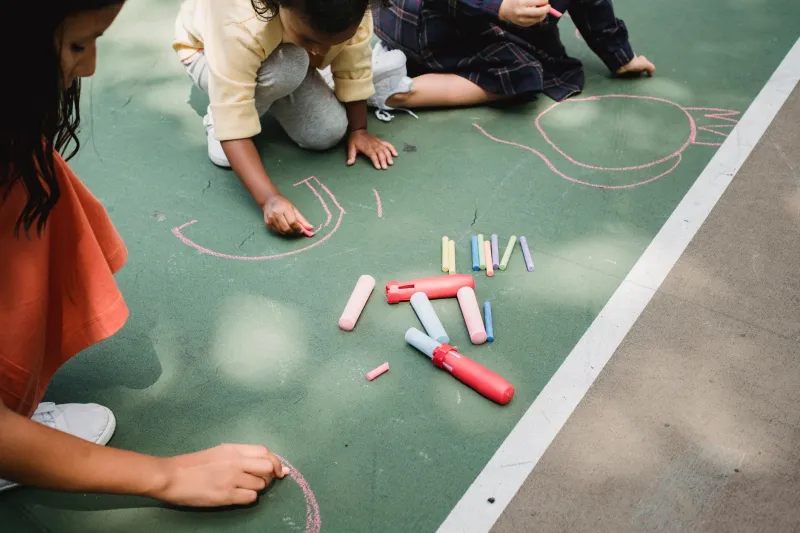
Before children start jumping, ask them to find a puddle and draw around it in chalk. That simple outline does a lot of work. It makes the puddle visible as a shape, gives everyone a shared edge to talk about and stops the biggest puddle from being claimed by the loudest child. For younger children, the language is enough: big, small, long, wide, shallow, deep. For older children, the outline becomes a diagram. Which part is the perimeter? Which part is the area? Can you point to the difference without using the words first?
A useful prompt is: if an ant walked around the edge, how far would it travel? Then: if a tiny sheet of paper had to cover the water, how much paper would it need? Perimeter and area stop being vocabulary to memorise and become two different journeys around the same shape.
The three-minute prediction game
Puddles change quickly, which makes them perfect for estimation. Ask children to predict which of three chalk-ringed puddles will hold the most water, the least, or the longest before break ends. They do not need to agree. The value is in the reasons: this one is wider, that one is deeper, the one by the wall is in shade. Write the predictions on a slate or a clipboard, or simply chalk a tally beside each puddle. After ten minutes, return and compare.
This is data handling without the workbook. A quick tally of predictions, followed by a check, gives children a taste of making a claim and testing it. It also gives adults a natural way to ask: was it close? What surprised you? What would you change next time?
Chalk challenges for quick differentiation
One puddle can serve several ages if the questions are pitched well.
- EYFS and Year 1: find the biggest puddle, the smallest puddle, and a puddle shaped like a sausage. Count how many wellies fit around the edge.
- Year 2 and Year 3: measure the perimeter with footsteps, skipping ropes or a length of string. Compare two puddles and say which has the longer edge.
- Year 4 and Year 5: estimate area using a grid of chalk squares or sheets of newspaper. Count whole squares first, then talk about the tricky half-squares.
- Year 6: design a fair test. Does a puddle shrink faster in the wind or in the sun? Does it matter if the puddle is under a tree? What will you keep the same?
The key is to keep the challenge short. A wet break is not the place for a twenty-minute investigation. A single good question, asked at the right moment, can do more than a whole page of questions.
Fair-test thinking in wet weather
Puddles are messy, so fair-testing needs a light touch. If children want to know whether one puddle disappears faster than another, help them notice the variables: size, depth, shade, wind, foot traffic. They cannot control the weather, but they can choose two puddles that are similar and watch them over playtime. That is real scientific and mathematical thinking: compare like with like, record what happens, and accept that the answer may be untidy.
A simple recording format works well: a chalk timeline on the wall, with times written by an adult, and a tick for each puddle that is still there. Back inside, the ticks become a quick graph or a sentence: the puddle by the gate lasted longer than the puddle in the middle. No app required.
Safety and inclusion notes
Wet-break maths only works if it stays sensible. Check that puddles are shallow and in safe, visible areas. Avoid water near drains, steps, busy routes or anything that looks contaminated. Children should wear waterproofs and suitable footwear, and adults should watch for slipping. Nobody should taste puddle water, and everyone should wash hands before snacks. Keep the chalk away from eyes and clothes where possible, and have a cloth for wet hands.
Inclusion matters too. Some children cannot easily crouch, splash or move across a wet playground. Offer alternatives: a tray of water on a table, chalk shapes on dry tarmac, photos of puddles taken earlier, or a buddy system. Children with sensory sensitivities may prefer to watch and record rather than splash. The maths is in the noticing, not in getting wet.
A five-minute wet-break kit
You do not need much: a box of chunky chalk, a couple of skipping ropes or lengths of string, a clipboard, a pencil and a few question cards. Add a laminated sheet with prompts such as: which is widest? How many footsteps around the edge? What will change by home time? Keep it near the door so a wet break does not become a lost opportunity.
At Math Playgrounds, the best maths is often the maths children do not realise they are doing. A puddle is temporary, which is exactly why it works. It asks to be measured, compared and argued about — and then it disappears, leaving behind a child who has had a proper think in the rain.