Start With the Game, Not the Sticker: Why Play Should Be the Main Course in Primary Maths
In a lot of UK primary classrooms, the maths game is dessert. It arrives after the worksheet, after the input, after the marking. It is the Friday afternoon treat, the golden-time reward, the thing you get to do once the real learning is finished. At home, it is the sticker at the end of the page. I think that is backwards, and I think it wastes one of the best teaching tools we have.
The dessert problem
Picture a Year 4 classroom on a Thursday morning. The children have spent twenty-five minutes on column addition. The teacher has modelled it, the children have practised it, and now the fast finishers get a maths game on the tablet while everyone else catches up. The game is not part of the lesson. It is a reward for finishing, or a holding activity for the ones who did. Either way, it has been demoted.
That demotion matters. When a game is only a reward, children learn a quiet lesson: maths is the work, and games are what you do when the work is over. Play becomes something separate from thinking. It becomes a sticker, a bit of sugar, a signal that the serious stuff has stopped.
But a well-chosen game is not a break from learning. It is a different door into the same room. A ten-minute game can introduce a concept, give low-stakes practice, or show a teacher exactly what a child understands. That is not dessert. That is the main course.
Introduce: let the game create the need
Start with a game and you give children a reason to care about the maths that follows. In a Year 2 classroom, a simple ‘race to 100’ game with a hundred square and two dice can introduce place value before anyone writes a formal sum. Children roll, move, count and argue about whether they have crossed a ten. The teacher does not need to explain place value first. The game creates the need for it. Afterwards, the class can look at the hundred square together and ask why some moves feel bigger than others.
At home, the same idea works at the kitchen table. Before a home-educated child starts a worksheet on money, play a quick shop game with real coppers and pound coins. Give them a budget and a price list. Let them make mistakes. The worksheet then becomes a record of something they have already done with their hands.
This is not a fluffy warm-up. It is a deliberate sequence: experience first, label second. Children meet the idea in action, then the teacher gives it a name.
Practise: repetition without the slump
Practice does not have to mean a page of thirty identical questions. A game can give the same number of repetitions with more feedback and less dread. A times-table game with cards, a fraction-matching game, a loop card activity, a playground relay — all of these can get children saying number facts aloud, checking each other and correcting mistakes in real time.
The key is that the game must be about the maths, not about the score. If children are racing to collect tokens, they may learn to tap quickly and think slowly. If they are racing to explain a strategy, they learn something else. A good classroom game has a debrief. Two minutes at the end — ‘Which round was hardest? Why did that happen?’ — turns a bit of fun into a lesson.
Assess: watch the play, not just the answers
Some of the richest assessment I have seen happens while children are playing. A Year 5 pupil playing a fraction card game might sort one-half, one-third and one-quarter correctly, then hesitate over two-quarters. That hesitation is data. A teacher can note it, ask a question and adjust the next day’s starter. A worksheet might have shown the same misconception, but the game shows the thinking as it happens.
For home educators, this is especially useful. You do not need to mark a hundred questions to know whether a child understands. Play a short game, listen to their reasoning, and keep a note. The game is the assessment.
Make play the main course
So how do we stop treating games as pudding? Start small.
Swap one worksheet warm-up for a game that uses the same skill. Instead of a page of rounding questions, play a rounding relay with number cards. Instead of a written starter on shapes, give pairs a set of shape cards and ask them to sort by property. The learning objective stays the same; the route changes.
Plan the debrief before the game. If you cannot say what you will ask afterwards, the game may become a time-filler. A single question — ‘What strategy helped you?’ — is enough to turn play into learning.
Do not grade every game. The moment every game becomes a scored assessment, children stop taking risks. Some games should be for exploration only.
Let children design a game. A Year 6 class asked to invent a game for equivalent fractions will have to understand equivalent fractions. That is not a reward. That is the lesson.
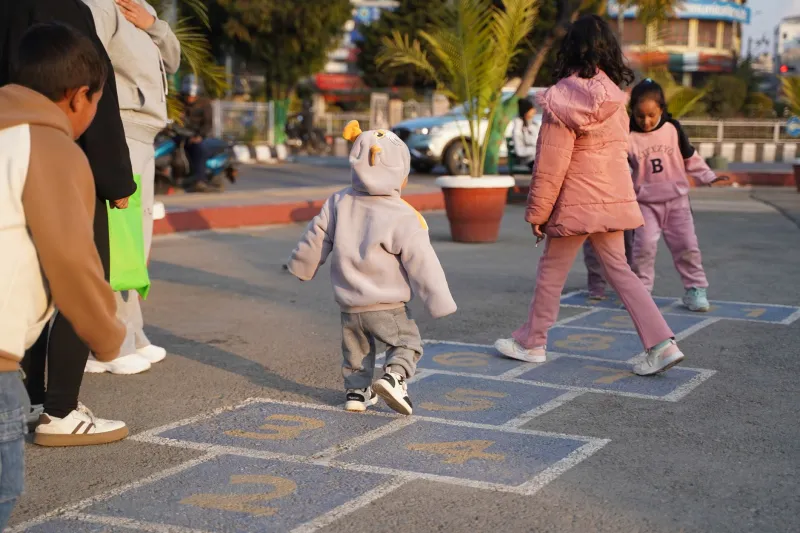
Use the playground. Active games are not a break from numeracy; they are numeracy with legs. A skipping game with times-table chants or a hopscotch grid with fractions can do what a worksheet cannot.
But what about behaviour?
Yes, games can be noisy. They can get competitive. They can produce the child who sulks when they lose. That is not a reason to banish them. It is a reason to teach the routines: how to shuffle cards, how to take turns, how to say ‘good game’ even when you did not win. Those are social skills as much as maths skills.
If we keep games as dessert, children learn that maths is something to endure and play is something to earn. If we make games the main course, they learn that maths is something you do — with your hands, with other people, with a bit of noise and a lot of thinking. That is a better lesson, and it does not need a sticker.