Call It a Rule, Then Move: Five Playground Games for Early Algebra
Algebra has an image problem. Mention the word to many parents and they picture x, y and a worksheet full of brackets. Mention it to many children and they picture something that starts in Year 6, just before secondary school. But early algebra is much friendlier than that. It is rule-spotting. It is asking what stays the same and what changes. It is saying, in words, what happens when a number goes into a machine.
The playground is a good place to practise that kind of thinking because it makes the rule visible. Children can be the numbers, the machine, the output and the clue. No worksheets, no special kit and no need to wait until the summer term of Year 6. Here are five games that work with a class, a small group or a family in the park.
Start With the Rule, Not the Letter
A function machine is simply a rule. Put a number in, follow the rule, get a number out. If the rule is add three, then 4 becomes 7 and 10 becomes 13. Children who can describe that rule in everyday language are already doing algebraic thinking. The letters can come later. The important part is generalisation: noticing that the same rule works for every input, not just the one in front of them.
In 2026, with so much primary maths still sitting on screens and in workbooks, it is worth remembering that movement is not a break from learning. It is another way in. These games are short, social and easy to repeat. A five-minute burst before lunch can do more for rule-finding than a page of fill-in-the-gaps.
1. The Input-Output Relay
Set out two lines about ten metres apart. One line is the input zone; the other is the output zone. The caller stands to one side and gives each runner a number. The runner walks quickly to the output zone and calls back the answer after applying the secret rule. The rest of the group watches and tries to work out the rule.
Start with one-step rules: add two, subtract one, double it. Then move to two-step rules such as double and add one. Keep the pace brisk but insist on walking. The game is about thinking aloud, not sprinting.
Progression tip: once the group knows the rule, ask for predictions. What would 20 give? What input would give an output of 15? That second question is where early algebra really begins, because it asks children to work backwards.
2. Balance-Beam Teams
Use a painted line, a kerb-free edge of the playground or an imaginary line down the middle. Two teams stand either side. Each side builds an expression with their bodies: three children on one side could mean 3, while two children plus one more could mean 2 + 1. The aim is to make both sides balance.
Once children are comfortable with equal values, add a mystery. One child on a side turns their back or hides behind the line so nobody can see their number. The group has to work out what that hidden value must be to keep the balance. That hidden child is a variable in human form, and children usually grasp the idea faster when they can see it.
Progression tip: move from numbers to expressions, such as 4 + 2 on one side and 3 + 3 on the other. Then try a missing value: 5 + ? = 8. Ask children to explain how they know, not just to call out the answer.
3. Mystery-Rule Tag
This one needs a clear running area and a tagger with a secret rule. When the tagger tags a player, they call out an input number. The tagged player has a few seconds to call back the output. A correct answer frees them; a wrong answer means they join the tagger as a clue collector. After three clues have been shared, the whole group guesses the rule.
Keep the numbers small and the rules simple at first. A rule such as add five or double it gives quick, satisfying answers. Later, use a two-step rule and let the clue collectors whisper input-output pairs to each other.
Progression tip: ask children to record the clues in their heads as pairs: 2 gave 6, 3 gave 7, 4 gave 8. Then ask what the rule must be. This is pattern-seeking, and it is the heart of algebraic reasoning.
4. Variable Hopscotch
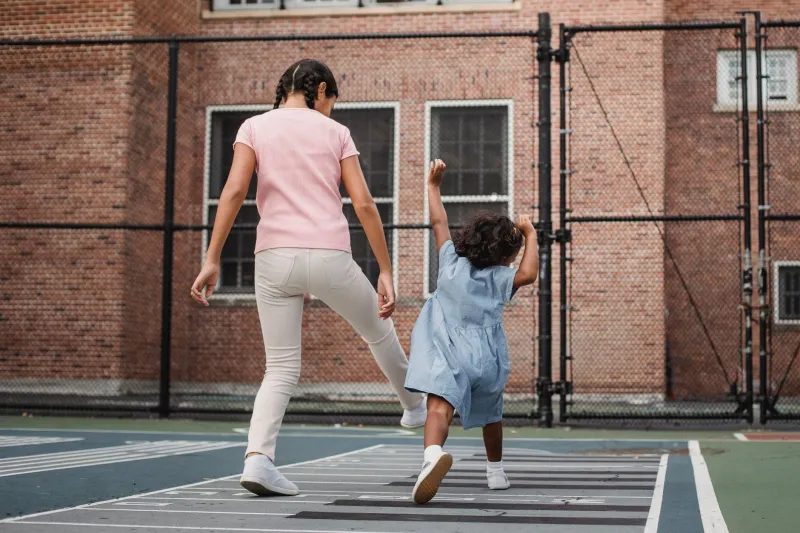
Find a painted hopscotch grid or mark out a simple row of squares. Give each square a number, but make one square the mystery square. Call it n or the secret step. Children hop the sequence and say the value they land on. If the secret step is 2 and the rule is add the square number, the caller can ask what happens when the secret step changes.
A simpler version works for younger KS2 children: every square adds one more than the last, and the mystery square is whatever number they choose. The game becomes a conversation about what would happen if the mystery square were bigger, smaller or zero.
Progression tip: move from a single mystery value to a rule. If the secret step is n, what is the next square? What about two hops on? Children can answer in words long before they write n + 1.
5. The Human Function Machine
Two children become the machine. They agree on a rule, such as add four or double and subtract one. A runner whispers an input to the first machine child, who passes the number through the rule and whispers the output to the second machine child. The second child calls the output to the group. Everyone else tries to guess the rule from three or four examples.
The machine children have to agree on the rule and apply it consistently, which is a useful bit of maths talk in itself. If the outputs stop making sense, the group can ask the machine to test a new input. This turns the game into a genuine investigation rather than a guessing competition.
Progression tip: ask the machine to give the rule in a full sentence: The output is always double the input, plus one. That sentence is a generalisation, and it is exactly the sort of mathematical language we want children to own.
Progression Across KS2
In Year 3, keep to one-step rules with small numbers and lots of spoken reasoning. In Year 4, bring in multiplication and two-step rules, but keep the numbers friendly. In Year 5, ask children to find missing inputs and to describe rules in words. By Year 6, they can begin to use simple symbols, but only after they can explain the rule clearly without them.
The same five games can be played across the whole of KS2. The difference is the rule, the numbers and the questions you ask. A Year 3 group might spend ten minutes on add two. A Year 6 group might spend ten minutes arguing about whether two different rules could produce the same outputs.
Keeping It Fair and Safe
These games work best with walking or light jogging, clear boundaries and a midday supervisor or teacher nearby. Make sure every child gets a turn as caller, machine or rule-setter, not just the quickest runners. Children who prefer not to run can be the recorders, the clue collectors or the people who ask the questions. That is not a consolation prize; questioning is the mathematical heart of the game.
The Point of It All
When a child shouts, It is double plus one, they are doing algebra. They are noticing a pattern, describing it generally and testing it against new inputs. The playground did not make the maths easier. It made the maths visible. And once children can see the rule, the letters and symbols have something real to attach to.