The Two-Pound Maths Lab: Rewriting the Rules of Second-Hand Board Games
Charity shops are full of half-finished board games. The box is battered, the instructions are missing, and nobody is entirely sure whether the green counter is a hat or a tree. That is not a problem. It is an opportunity. A 50p game with a torn lid is a maths kit waiting for a new rulebook — and the child who helps rewrite that rulebook is doing numeracy work without ever being told to sit down and practise.
The trick is not to turn family game night into a worksheet with dice. It is to bend the game just enough that numbers become part of the fun: a score to beat, a risk to weigh, a budget to protect. Here is how to raid the charity-shop shelf and build a two-pound maths lab at the kitchen table.
Start with the shelf, not the worksheet
You do not need a complete game. In fact, missing pieces can be useful. Look for anything with at least one of these: dice, play money, a numbered track, cards with values, or a spinner. Snakes and Ladders, Ludo, Monopoly, Connect 4, dominoes, playing cards, and generic race-to-the-finish games are all fair game. Check the pieces before you buy — not because you need a full set, but because you want enough counters to avoid arguments.
A quick checklist for the charity-shop rummage:
- Dice: two or more is ideal.
- A track or board with numbered spaces.
- Play money or cards with prices.
- Counters, even mismatched ones.
- A box that closes, so the cat does not help.
If the instructions are missing, even better. You are not reconstructing someone else's game. You are writing your own.
Remix one: scoring is a dial, not a law
Most children learn quickly that the number on the dice tells you how far to move. That is a fine start, but it is not the only rule in the universe. Try changing what a turn is worth.
For a simple track game, keep the movement rule but add a score sheet. Each turn, the player rolls two dice and moves the total. They also write down the product of the two numbers. After ten turns, the highest total score wins — or the lowest, if you want to practise subtraction. For a child in Year 4, this is multiplication practice disguised as a race. For an older child, use one die and one operation card (add 2, double, subtract 3). The movement stays familiar; the arithmetic becomes the game.
The important bit is that you change only one rule at a time. If you rewrite movement, scoring, and the win condition in one go, you have invented a new game and lost the children. Keep the original win condition for the first round. Let them feel the maths before you add another twist.
Remix two: make the dice lie a little
Probability is where charity-shop games earn their keep. A standard die is fair, but a homemade die is more interesting. Cut small squares of paper and stick them onto a die, or use a blank wooden cube from a craft shop. Make a die with faces 1, 1, 2, 3, 3, 6. Ask: is this die fair? Which number will come up most often? Roll it twenty times and tally the results.
Then compare it with a normal die. Which one would you choose for a game where you need to move exactly four spaces? Which one is better for a game where high numbers are bad? This is not a statistics lecture. It is a conversation with dice in hand. Children will argue about fairness, and that argument is the learning.
You can do the same with two dice and a Ludo board. Before each turn, ask whether the player wants one die or two. Two dice give a higher average, but also more chance of a specific total. Let them experiment. The language of likely, unlikely, and evens will appear on its own.
Remix three: give them a budget and a bad deal
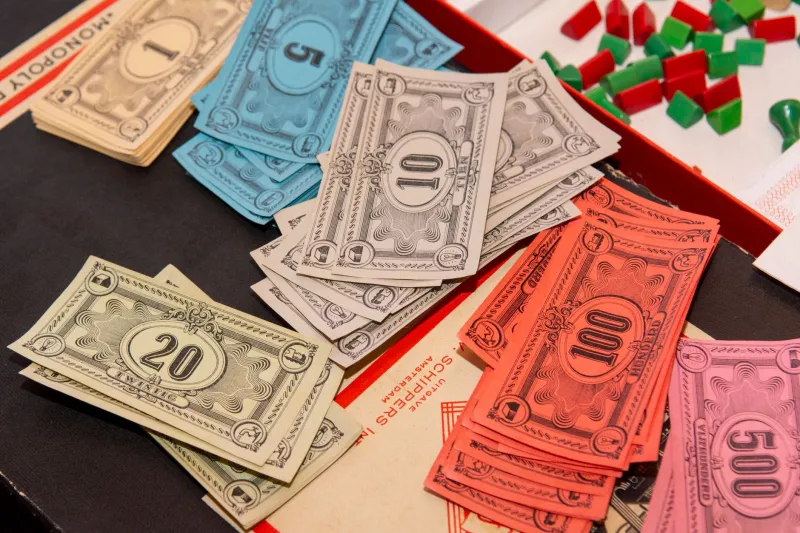
Play money is the most underrated maths tool in any charity-shop box. Monopoly is the obvious candidate, but you do not need the whole game. Use the money and property cards to run a mini budget challenge.
Give each child £20 in play money. Set a timer for ten minutes. They must buy at least three properties, keep £5 in savings, and pay a 10% service charge on every purchase. The banker — a role every child should have a turn at — checks the sums. If you want to add percentages, make the service charge 20% for one round and 5% for the next. Ask which round felt easier and why.
For younger children, skip the percentages and use rounding. Every price ends in 99p. Round it to the nearest pound before buying. How much have they saved or overspent? This is estimation, not precision, and that is fine. Estimation is a genuine maths skill, and it is often the one children use most in real life.
The five-minute setup
The best remixes are the ones you can explain in a sentence. If the rule takes longer to explain than the game takes to play, simplify it. Here is a quick setup for a rainy Saturday:
- Choose one game from the charity-shop pile.
- Change one rule only — scoring, dice, or money.
- Play one short round.
- Ask one question: what did you notice?
- Stop while it is still fun.
That last point matters. A maths game that overstays its welcome teaches children that maths is something to endure. A game that ends with them wanting one more turn teaches the opposite.
What by accident actually looks like
You will not see a worksheet. You will see a child arguing that a 1, 1, 2, 3, 3, 6 die is better for a game where you need low numbers. You will see them counting coins, rounding prices, and keeping a score sheet without being asked. You will hear that it is not fair — and then a reasoned explanation of why. That is the maths. It is happening by accident, which is often the best way.
So next time you pass a charity shop, look at the board games shelf with different eyes. The box may be tatty. The pieces may be wrong. The instructions may be long gone. But for 50p, you can bring home a maths lab that fits on the kitchen table — and a game your family will actually want to play.